


Moses, Pharaoh, and Luqman: A Quranic Look at Right and Left Brain Balance

Some stories in the Quran do more than teach history. They hold up a mirror to the inner life.
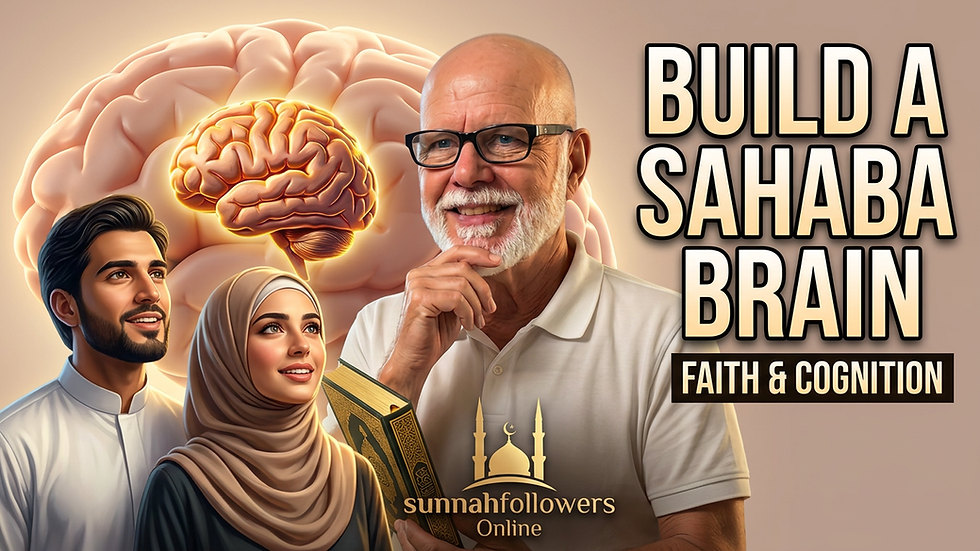
This week, Dr. McBride used the story of Prophet Moses, his brother Aaron, Pharaoh, and Luqman to explain the difference between right-brained and left-brained ways of seeing the world. The point was not to turn the Quran into a neuroscience textbook. The point was to use familiar brain-language as a lens.
In simple terms, the right brain is often linked with big-picture awareness, emotional reading, humility, intuition, and connection. The left brain is often linked with logic, language, control, structure, and sharp analysis.
Real human beings use both sides. The brain is far more connected than popular labels suggest. Still, as a teaching tool, the contrast is powerful.
Moses shows emotional depth, self-awareness, and vision. Aaron shows support, communication, and relational strength. Pharaoh shows what happens when intellect becomes detached from humility. Then Luqman gives us a fuller picture, a person of wisdom whose heart and mind work together.

Right-brained and left-brained language is a metaphor
Before looking at the Quranic examples, it helps to set the frame with care.
When people say someone is “right-brained,” they usually mean that person is intuitive, creative, emotionally aware, and able to read the whole situation. When people say someone is “left-brained,” they often mean that person is logical, orderly, verbal, precise, and focused on control.
Those labels can be useful, but only if we keep them humble.
A person is not literally only one side of the brain. Moses was not without reason. Pharaoh was not without intelligence. Luqman was not balanced because he split his life into two neat halves.
The lesson is deeper. It is about how different qualities rule the soul.
A heart-led person can see beyond fear. A mind-led person can organize truth into action. But when the mind becomes arrogant, it can argue against what the heart already knows. When emotion lacks discipline, it can become scattered. Balance matters because truth needs both perception and practice.
The Quran often teaches this kind of balance. It calls people to reflect, remember, observe, give thanks, speak the truth, pray, and act justly. These are not divided virtues. They belong together.
Moses shows vision, humility, and emotional intelligence
Allah to expand his chest, make his task easier, and untie his tongue
He sees the big picture beyond the immediate threat.
He reads the emotional and social weight of the situation.
He recognizes his own limits without shame.
He values relationships and support.
He cares about whether the message lands in people's hearts.
Self-awareness is easy to admire but hard to practice. Many people would rather fail alone than ask for help. Moses does the opposite. He asks his Lord for support, then names the person who can strengthen the mission.
This is not insecurity. It is mature confidence.
Aaron shows that communication is part of truth
Aaron, peace be upon him, is sometimes mentioned in Moses' shadow, but his role matters deeply. Moses asks Allah to strengthen him through Aaron because Aaron can help him speak and carry the message.
That teaches a subtle lesson: truth is not only about being right. Truth must also be conveyed with clarity, care, and steadiness.
Aaron’s role shows the relational side of leadership. He stands with Moses. He supports the mission. He helps shape a message that must confront one of the most arrogant rulers in history.
In everyday life, this matters. Some people carry deep insight but struggle to express it. Others can speak clearly but need a strong moral center. Some can sense what is wrong but need someone beside them to give structure and courage. The best work often happens when people know their strengths and admit their limits.
Moses and Aaron together show a deeply spiritual model of cooperation. No one competes with the other in their prophetic partnership. Moses does not resent Aaron’s gift. Aaron does not use his gift to replace Moses.
They serve the same truth.

Pharaoh shows intelligence without humility
Pharaoh is the contrast.
He is not presented as foolish in the simple sense. He has power, strategy, command, and influence. He knows how to control people. He understands public image. He gathers his chiefs and magicians. He speaks in a way that protects his authority.
In that sense, Pharaoh has many traits people might loosely associate with an extreme left-brained approach: control, argument, hierarchy, calculation, and rigid certainty.
But the Quranic problem isn't what Pharaoh thinks. The problem is that he thinks without humility.
He sees signs, yet refuses to submit. He witnesses what should soften him, yet his arrogance grows. He is so self-centered that he claims a status no human being can claim. His inner world has become closed. No sign can enter. No warning can humble him. No truth can reach him because he has made himself the center of reality.
That is the danger of an unbalanced mind.
Reason is a gift, but pride can corrupt it. Speech is a gift, but it can become manipulation. Leadership is a gift, but it can become domination. Certainty is useful when rooted in truth, but deadly when rooted in ego.
Pharaoh’s tragedy is not lack of evidence. It is refusal. The Quran shows him choosing himself over truth.
This is where the right-brain and left-brain metaphor becomes morally serious. A purely controlling mind wants to master what it should surrender to. It prefers power over guidance. It treats people as tools. It cannot weep, listen, or bow.
Pharaoh’s failure is the failure of a brilliant ego.
The signs were clear, but Pharaoh’s heart was sealed by pride
The story of Moses and Pharaoh is filled with signs. There is the staff. There is the confrontation with the magicians. There are warnings and consequences. Again and again, Pharaoh has opportunities to turn back.
What makes the story so haunting is that Pharaoh isn't denied access to the truth. He is exposed to it.
After seeing the truth of Moses’ sign, recognize what Pharaoh refuses to recognize. Their hearts respond. They move from performance to faith. By contrast, tightens his grip.
That contrast matters. The same event can humble one person and harden another.
The difference is not always information. Sometimes it is posture.
A humble person can receive a sign and change. An arrogant person can see the same sign and begin building an argument against it. Pharaoh’s mind is active, but it serves his pride. He does not use reason to seek truth. He uses reason to defend his throne.
This warns anyone who loves knowledge, debate, analysis, or control. These gifts are not wrong. They become dangerous when they no longer answer to Allah.
The heart must guide the mind, and truth must discipline the heart.
Luqman shows the beauty of balance
After contrasting Moses and Pharaoh, Dr. McBride turned to Luqman. That shift matters because Luqman offers a different kind of model.
The Quran does not introduce Luqman as a king or prophet. He is known for wisdom. The Quran presents his advice to his son, and in that advice we see a person who is deeply balanced.
He begins with the foundation of faith. He warns his son not to associate partners with Allah. This is spiritual clarity. It is not vague emotion. It is the left-brain strength of correct order: know who your Lord is, know what reality is, and do not confuse creation with the Creator.
Then he speaks about gratitude, especially toward parents, while also making clear that obedience to parents does not outrank obedience to Allah. That is emotional and moral balance. Love is real, but it has limits. Gratitude matters, but truth comes first.
Then Luqman teaches that Allah knows even the smallest deed, in the heavens or on earth. A mustard seed, hidden in a rock, in the heavens, or on earth, is still within Allah’s knowledge. This is a stunning combination of imagination and accountability. It expands the heart while sharpening the conscience.
He tells his son to establish prayer, enjoin what is right, forbid what is wrong, and be patient. These are not only feelings. They are practices. They take discipline, structure, and courage.
Then he warns against arrogance. Do not turn your cheek away from people. Do not walk proudly on the earth. Be moderate in pace. Lower your voice.
This is wisdom made practical.
Luqman is not merely emotional. He is not merely analytical. He knows theology, family ethics, social manners, worship, patience, humility, and speech. He understands the unseen and the everyday. He speaks to the soul, but he gives clear instructions the body can follow.
That is balance.

Luqman’s advice joins the heart and the mind
Luqman’s counsel to his son is tender, but it is not soft in the weak sense. It is loving and firm at the same time.
That combination is rare.
Some people speak the truth without mercy. Others offer comfort with no direction. Luqman does neither. He gives his son a map for life, one that includes both inner and outer guidance.
His advice includes:
Belief
Worship Allah alone and keep the foundation clear.
Gratitude
Recognize your parents' rights and the blessings around you.
Accountability
Know that no deed is too small to matter.
Worship
Make prayer a lived practice, not just an idea.
Moral courage
Call to what is right and stand against wrong.
Patience
Expect difficulty when living by truth.
Humility
Do not look down on people or move through the world with pride.
Self-control
Be measured in how you walk and how you speak.
This is not random advice. It is a complete pattern of life.
The heart needs belief, gratitude, humility, and tenderness. The mind needs clarity, order, responsibility, and discipline. The body needs prayer, control of speech, and ethical action. Luqman brings all of these together.
Where Pharaoh is inflated, Luqman is grounded. Where Pharaoh performs power, Luqman teaches wisdom. Where Pharaoh refuses to bow, Luqman teaches his child to live under Allah's gaze.
The real lesson is integration
If Moses shows emotionally aware courage, Aaron shows supportive communication, Pharaoh shows intellect corrupted by ego, and Luqman shows balanced wisdom, then the lesson becomes clear.
A believer should not aim to be only emotional or only rational. The Quran calls for the whole person.
We need the Moses-like ability to see the mission and admit our limits. We need the Aaron-like ability to support truth with clear speech. We need to reject Pharaoh’s arrogance when it appears in smaller forms inside us. We need Luqman’s balance, where faith becomes manners, worship becomes character, and wisdom becomes daily action.
The danger is not the left brain. The danger is control without surrender.
The danger is not the right brain. The danger is feeling without guidance.
A balanced soul does not silence the mind or ignore the heart. It lets revelation guide both.

A practical way to read these stories today
These Quranic stories are not distant. They ask direct questions.
When facing a hard responsibility, do we react like Moses, asking Allah for help, clarity, and the right support? Or do we hide our weakness because pride feels safer?
When someone else has a gift that strengthens the work, do we welcome them like Moses welcomed Aaron? Or do we compete?
When truth challenges our comfort, do we soften? Or do we become a miniature Pharaoh, defending our image even when we know better?
When advising someone younger, do we speak like Luqman, with faith, wisdom, tenderness, and practical direction?
Right-left brain language gives us a simple way to notice patterns, but the Quran offers a deeper cure. It calls us to humility before Allah, justice with people, discipline in worship, and gentleness in conduct.
Moses teaches courage with self-knowledge. Aaron teaches the beauty of support. Pharaoh warns us against the prison of ego. Luqman teaches balance that begins with tawheed and extends into how we walk and speak.
That is the real goal: not to become more “right-brained” or more “left-brained,” but to become more whole under the guidance of Allah.
Live Lecture: https://youtube.com/live/wIETpOrFCQk?feature


Comments