


Uthman’s Legacy and Rightful Succession: Clearing Historical Myths

Few figures in early Islamic history are praised so deeply yet so widely misunderstood as Uthman ibn Affan, may Allah be pleased with him. His name is tied to generosity, modesty, public service, preserving the Qur’an, and one of the most difficult political periods the Muslim community ever faced.
In this week’s session on the Caliphate of Uthman, Ustadh Mukhtar Shaheed focused on more than dates and events. He discussed Uthman’s character, his early sacrifices, the famous Well of Charity, and the Shura Council that selected him as the third rightly guided caliph. He also addressed a major problem in how many people read this period: later rumors are often treated as if they carry the same weight as established reports.
That mistake has shaped many misconceptions. Some stories portray Uthman’s nomination as suspicious. Others suggest that the community did not accept him. Some reduce his rule to political tension while ignoring the principles, achievements, and consensus that marked his succession.
A fair study of Uthman’s life gives a different picture. His succession was not a hidden arrangement or a tribal takeover. It came through consultation, public acceptance, and the trust of the senior Companions.
Uthman’s early life showed nobility before authority
Uthman ibn Affan, may Allah be pleased with him, came from a respected family in Makkah. He was known for his dignity, good manners, business acumen, and gentle nature. Even before Islam, he was not known for the crude habits that marked parts of pre-Islamic society. His personality carried a natural restraint.
When Islam came, Uthman accepted it early. His conversion was not a matter of social convenience. It placed him among a persecuted minority and pressured his position in society. Like other early Muslims, he faced hardship for choosing faith over status.
His life also became closely connected to the household of the Prophet Muhammad, peace and blessings be upon him. Uthman married Ruqayyah, the Prophet's daughter, and migrated with her to Abyssinia when Muslims sought safety from persecution. After her passing, he later married Umm Kulthum, another daughter of the Prophet. For this reason, he became known as Dhu al-Nurayn, the possessor of two lights.
That title is not a small biographical detail. It reflects the honor he held among the earliest Muslims and the trust the Prophet’s household placed in him.
Uthman’s identity was not built by office. His office later revealed what had already been present: faith, restraint, sacrifice, and generosity.
The Well of Charity preserved a living lesson in service
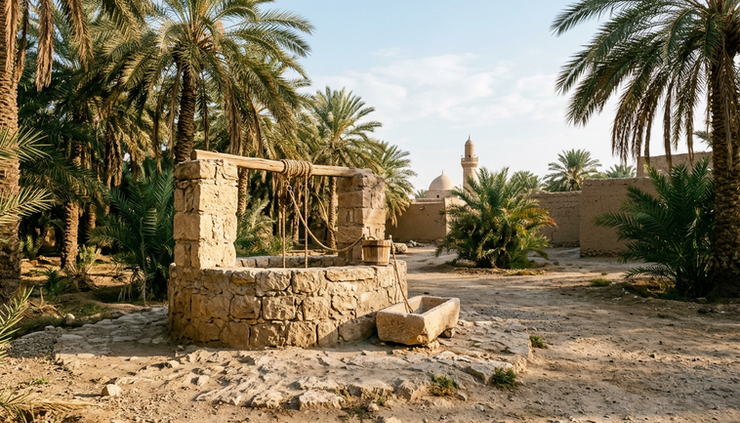
One of the clearest examples of Uthman’s character is the Well of Rumah, often remembered as the Well of Charity. In Madinah, access to water mattered deeply. Water was not a luxury. It supported families, travelers, animals, farms, and daily life.
Reports say Uthman purchased a well and made its water available to Muslims. This act became one of the most famous examples of charitable giving in Islamic history. It was not charity for display. It met a direct public need.
People still remember the well today, and the charitable legacy connected to it remains part of how Muslims speak about Uthman. Whether one studies it as history, inspiration, or religious memory, the lesson is clear: Uthman’s wealth became a means of service.
His giving was not limited to water. He is also remembered for major contributions during times of community need, including support for the army in times of hardship. These acts show a pattern. Uthman did not treat wealth as a private monument to himself. He used it to strengthen the Muslim community.
That matters when studying his caliphate. A person’s character before power helps us understand how he wielded it after he received it. Uthman’s public life did not begin with politics. It began with sacrifice.
Historical rumors grew during a time of fitnah
The later years of Uthman’s caliphate were marked by unrest. The Muslim world had expanded quickly. New regions entered the Islamic state. Communities differed in language, tribal background, local concerns, and political expectations. Administrative problems became harder to manage.
In that environment, rumors spread. Some were based on partial truths. Some came from political anger. Some were shaped by later sectarian debates. Others were simply fabricated.
Ustadh Mukhtar’s session highlighted an important method: not every story in a history book carries the same authority. Early Muslim historians often collected reports with chains of transmission. They preserved material, including weak and conflicting reports, so later scholars could examine them. A report’s presence in a historical work does not automatically make it reliable.
This is especially important when reading about the Companions. The Qur’an and Sunnah establish their virtue broadly and clearly, while isolated reports may make claims that clash with their known character. A fair reader does not accept every accusation at face value.
Several common myths about Uthman follow the same pattern:
His election was supposedly arranged in secret.
The Shura Council was supposedly manipulated.
Senior Companions supposedly rejected his leadership.
His caliphate supposedly lacked legitimacy.
His character was supposedly weak because he was gentle.
These claims need evidence. When examined carefully, they do not overturn the stronger historical picture of consultation, public pledge, and broad acceptance.
The Shura Council was a serious process, not a staged event
Before his death, Umar ibn al-Khattab, may Allah be pleased with him, did not appoint his own son or hand power to a private ally. Instead, he named a council of senior Companions who were widely respected and close to the Prophet, peace and blessings be upon him.
The well-known members of this council were:
Member of the Shura | Role in the process |
Uthman ibn Affan | Candidate and senior Companion |
Ali ibn Abi Talib | Candidate and senior Companion |
Abd al-Rahman ibn Awf | Senior Companion who helped lead consultation |
Sa’d ibn Abi Waqqas | Senior Companion and council member |
al-Zubayr ibn al-Awwam | Senior Companion and council member |
Talhah ibn Ubaydillah | Senior Companion and council member |
Abd al-Rahman ibn Awf played a central role after withdrawing himself from consideration. Reports describe him consulting widely before the final pledge. He spoke with leading figures, community members, and people connected to public life in Madinah.
The process ended with Uthman receiving the pledge of allegiance. Ali, may Allah be pleased with him, was also present and gave bay’ah. This matters because later rumors try to paint a picture of total rejection or a stolen succession. That picture does not match the broader record.
The Shura did not look like a modern election, and it should not be judged as one. It belonged to its own time and legal-political setting. Yet it clearly involved consultation, recognized leaders, public acceptance, and concern for unity.
That is why Muslim scholarship has long counted Uthman among the Rightly Guided Caliphs. His rule was not a historical accident. It was part of the accepted Sunni understanding of legitimate succession after Abu Bakr and Umar.
Uthman’s legitimacy rested on more than one argument
The case for Uthman’s rightful succession does not depend on one isolated report. It rests on several connected foundations.
He was among the earliest Muslims. His rank was not invented after he became caliph. He had served Islam from its earliest and most difficult days.
He had a close relationship with the Prophet’s household. His marriages to two of the Prophet's daughters, peace and blessings be upon him, reflected rare honor and trust.
He was chosen through shura. The council was not made up of unknown figures. It included leading Companions with deep standing in the ummah.
He received bay’ah. Legitimacy in early Islamic governance depended not only on nomination, but also on acceptance and pledge.
The major Companions did not establish a rival caliphate. Political disagreements and later unrest did not erase the original pledge.
His caliphate produced major service for the religion. Under his authority, the standardization and distribution of the Qur’anic text remain among the most important acts of preservation in Islamic history.
This is the heart of Uthman’s Legacy and Rightful Succession: his authority was rooted in character, consultation, acceptance, and service to the deen.

His style of governance reflected mercy and restraint
Uthman’s personality shaped his leadership. He was known for modesty and gentleness. These qualities are virtues, but in times of unrest, critics can misread them as weakness.
A harsh ruler may silence problems for a time. A merciful ruler may give people more room than they deserve. Uthman leaned toward patience. He avoided quick bloodshed. He tried to preserve unity and prevent internal fighting among Muslims.
This restraint should not be dismissed. The early Muslim community was not dealing with a simple administrative complaint. It was facing the early signs of fitnah, a trial that would later grow beyond one person or one city. Uthman’s reluctance to answer unrest with mass violence came from piety, not incompetence.
His governance also carried major accomplishments. The most famous was the standardization of the Qur’an’s recitation text for the growing Muslim world. As Islam spread, different communities learned from different teachers. Uthman acted to protect unity around the Qur’an by sending official copies to major regions and removing causes of dispute.
That act alone shows foresight. It was not merely administrative. It protected Islam's central text during a time of rapid expansion.
Clearing myths does not mean ignoring difficulties
A balanced view of Uthman’s caliphate does not deny that difficulties occurred. In his later years, his rule included complaints, unrest, accusations, and rebellion. Some governors were criticized. Some administrative decisions were debated. The Muslim state was growing, and growth brought pressure.
But studying challenges is different from accepting slander.
To clear myths about Uthman, three rules help:
Separate early evidence from later polemics. Read reports shaped by later political or sectarian conflict with care.
Judge the Companions by their established virtue. A doubtful accusation should not outweigh a lifetime of proven service.
Read events in context. The caliphate was governing a fast-growing world, not a small town with simple needs.
This approach does not flatten history. It makes history more honest.
The most harmful readings of Uthman’s era often begin with a conclusion and then search for reports to support it. A better method begins with what is well established: his early Islam, his generosity, his closeness to the Prophet’s family, his selection through shura, his public acceptance, and his recognized place among the Rightly Guided Caliphs.
The lasting lesson of Uthman’s legacy
Uthman ibn Affan, may Allah be pleased with him, left a legacy that cannot be reduced to the turmoil that ended his life. He was an early believer, a generous giver, a modest servant of Allah, a husband honored by the Prophet’s household, a caliph chosen through consultation, and a leader whose service helped preserve the Qur’an for the ummah.
Historical myths often survive because they are dramatic. They offer conflict, suspicion, and simple villains. The truth is more serious. Uthman’s story asks readers to value evidence over rumor, restraint over rage, and principled leadership over political noise.
His life also reminds us that public service begins before public office. The same Uthman who gave water through the Well of Charity later carried the burden of governing a growing Muslim world. His generosity, modesty, and patience were not side notes. They were central to his character.
To study Uthman fairly is to recover a model of leadership rooted in faith and trust. It is also to learn how easily history can be distorted when rumors are repeated without care.
The takeaway from Ustadh Mukhtar Shaheed’s session is clear: Uthman’s rightful succession stands on strong ground, and his legacy deserves to be read with knowledge, reverence, and justice.
Live Lecture: https://youtube.com/live/LwNJKTQNcFQ


Comments